




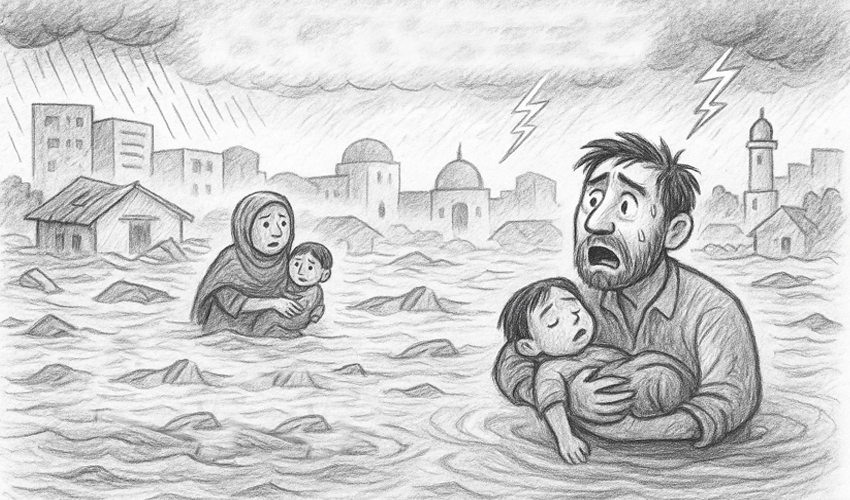
It never rains but it pours, and this time, literally so. The monsoon season has brought widespread devastation this year. Recent deaths, unprecedented destruction of buildings and infrastructure, and mass displacements – especially in Khyber Pakhtunkhwa, Gilgit-Baltistan and Azad Kashmir – are heartbreaking. Nationwide casualties have already exceeded 700 and are racing toward another century, for hundreds are still missing. That is more than double last year’s rain-related death toll of 354. As witnessed in KP’s Buner district, entire villages have been wiped out, with floods rendering hundreds of thousands homeless. And the worst part is that the monsoon season is not even over yet.
It is difficult to pin responsibility for the damage. The wrath of Mother Nature certainly played a role. However, it would be inappropriate to rule out administrative negligence and subsequent failures contributing to the scale of damage. Sadly, the debate would not change the fact that flashfloods have devastated people’s lives.
Even the relatively safer Punjab and Sindh could not escape what can only be described as nature’s fury. Karachi has also been hit hard this time around, leading to massive urban flooding and at least 16 deaths in two days. Parts of the city remain inundated for the third consecutive day, courtesy the clogged drainage system, encroachments blocking natural waterways, and unplanned development. Private property worth hundreds of billions of rupees has already been lost, for which compensation is unlikely. The suffering of Karachiites is palpable, as they now face not only destruction of their belongings but also the overwhelming burden of rebuilding their lives amid ongoing situation.
Although Pakistan has faced annual flooding in recent years, the intensity this season feels high. More importantly, the catastrophic surges caused by ongoing rains and cloudbursts in the northern region have again pointed to the country’s vulnerability to climate change. Those calling it an abnormal situation might have missed the warning signs by climate experts.
It is high time the government put stronger checks on deforestation, mining and unregulated constructions, especially on fragile slopes. Authorities must force some sense – if they have to – into those who treat floodplains as real estate opportunities
If anything, recent floods have made one thing clear that we are far from bearing the effects of global warming, let alone warding them off. Considering how human activities have worsened the impact of seasonal phenomena, it is high time the government put stronger checks on deforestation, mining and unregulated constructions, especially on fragile slopes. Authorities must force some sense – if they have to – into those who treat floodplains as real estate opportunities. In addition, survivors ought to be relocated to safer areas, and stopped from returning to their damaged homes, for that would be counterproductive.
Pakistan contributes less than 1 percent of total global emissions; still it is among the countries most vulnerable to climate change. Despite losing a lot, the country still has time to rebuild. To avoid further losses, authorities must pair short-term relief efforts with long-term strategies. Moreover, Pakistan must press for greater climate finance from high-emission countries to fund adaptation measures, for it is bearing the cost of their development. These cloudbursts and subsequent floods are just a wake-up call, and ignoring them this time would be a grave mistake.