




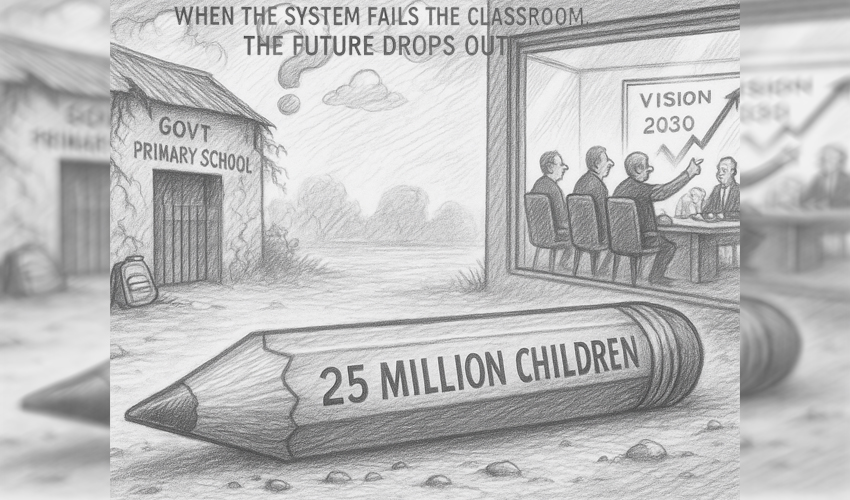
The era of AI-driven information technology demands, or rather dares, nations to dream big to achieve bigger success. However, it would be ridiculous to let a big chunk of an entire generation become illiterate daydreamers and then expect the country to progress.
A shocking report prepared by the Pakistan Institute of Education, Ministry of Education, and Japan’s bilateral aid agency JICA lays bare that more than 25 million Pakistani children aged 5-16 are out of schools. The statistics are both an indictment and a tragedy that mock the promises of universal education repeated countlessly in political manifestos and international commitments. Still, the education crisis the “Pakistan’s Non-Formal Education Report 2023-24” talks about is not something new or sudden per se.
Decades of socio-economic inequalities and marginal budgetary allocations remain the main contributing factors to this dilemma. Projects like Daanish Schools, educational scholarships under Parha Likha Punjab (Literate Punjab), and stipends for enrolments are some of the commendable steps taken by successive governments to boost literacy rate, but they have largely remained fragmented.
It is also unfortunate that the state, as well as provinces after the 18th Constitutional Amendment, never declared an education emergency in true sense. Those with political will and long-term plans stepped back when it came to allocation of funds, while others could not produce desired results due to poor planning and messed-up priorities. Resultantly, the country’s literacy rate hovers around 60 percent without any noteworthy progress in the last 20 years or so. The situation made room for the private sector and non-governmental organizations to step in and work on both pedagogy and andragogy (adult education). However, most of these initiatives remained short-lived and unsustainable due to low quality and high dropout rates.
The document presents an ugly picture, which should be enough to jolt policymakers to look for out-of-the-box solutions to the persistent problem. While doing so, they must look for ways to transform the education sector instead of managing it like before
The current non-formal education centers, heralded as an alternative route, are doing remarkable work in plugging the widening gap. However, they are not, and must never be, mistaken for a long-term substitute to a functioning and inclusive formal education system. There is no doubt that the NFE centers and the uptake in Accelerated Learning Programs have good intent behind them, but these interventions would be useless if not supplemented with structural reforms at the grassroots level. Moreover, the report’s special focus on female education demands that the governments, instead of relying on educated women to contribute to the economy, break the barriers that keep millions of girls away from classrooms.
The document presents an ugly picture, which should be enough to jolt policymakers to look for out-of-the-box solutions to the persistent problem. While doing so, they must look for ways to transform the education sector instead of managing it like before. It lifts the heart to know that the government is preparing a Federal Non-Formal Education Policy 2025 and a National Action Plan, but these would yield desired results only after addressing the inequities that render the “future of the country” invisible to the state. The state must step in to dispel the dangerous impression that school is a privilege and not a right. Otherwise, it would be gambling with not just the futures of 25 million children but also its own economic competitiveness.