





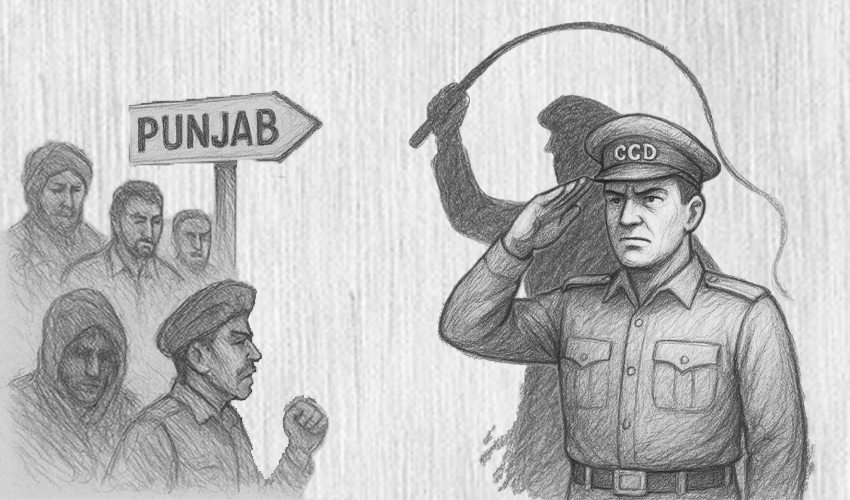
Nothing feeds chaos better than giving more power to those already beyond questioning. The Punjab government’s decision to expand the powers of the Crime Control Department may seem a necessary step against a rising tide of hard-to-handle crimes. The CCD will now take on land mafias, cybercriminals, gangs, drug traffickers, and harassers, along with other criminals often considered too powerful to touch. Although a welcome step, this new mandate is akin to flirting with danger.
Punjab has had a haunted past when it comes to policing. Absolute and unbridled power to any force rarely ends well and often tips into abuse. Since the 1980s, law enforcement has oscillated between being an instrument of justice and a tool of political vendetta. Security operations often turned into witch-hunts, leaving behind a trail of excesses committed by the very officers who had pledged to protect citizens. Although a nascent department, the CCD risks walking that same slippery slope. After all, selective action is almost inevitable when those carrying the gun also hold unchecked discretion. And herein lies the opportunity cost.
The CCD’s very creation in February this year sparked heated arguments, as the idea of a new force primarily inducted from various law enforcement agencies sounded irrational. Later on, its ‘unorthodox’ working added fuel to the fire, prompting many to raise their voice against what they called “illegal” and “extrajudicial” actions.
The fact that the upgrade puts the CCD on a par with the FIA is encouraging, as it now has the mandate to register and probe cases. Earlier, it largely assisted other law enforcers in intelligence gathering and coordinated raids, and lacked the authority to initiate legal proceedings on its own. However, officers now have the powers to lodge FIRs and arrest suspects independently, besides conducting full-scale inquiries.
Another welcome development is the digitization of all CCD systems, which would ensure transparent and speedy investigation. Additionally, the department has been tasked with compiling detailed records of organized squatting groups and revisiting cold cases related to land grabbing and other crimes. Now, with more power in their corner, their influence is likely to grow, and that has intensified the debate over their methods and boundaries of lawful authority.
Those at the helm must realize that their obligation begins, not ends, at empowering law enforcers. Ultimately, the law has to remain supreme, even in a war on crime
Yet, considering how crime is getting sophisticated and the way traditional policing is lagging behind, the CCD’s expanded capabilities are necessary. A specialized force with extraordinary authority sounds rational. But a force without a leash? That is a potential disaster in the making. While arming the CCD with sweeping powers, provincial authorities must not immunize the department from scrutiny.
The psychology of unchecked authority must not be ignored. After all, it is only normal for arrogance to replace accountability when an institution starts believing it is untouchable. Rulers must stay alert to this, and ensure proper review of the department so the expanded powers do not result in disregard for citizens or irresponsible conduct.
Those at the helm must realize that their obligation begins, not ends, at empowering law enforcers. Ultimately, the law has to remain supreme, even in a war on crime. Therefore, it is only sensible to fence the powers granted by clear rules, strict accountability, and independent oversight. Otherwise, in trying to kill the monster, we might just end up creating another.