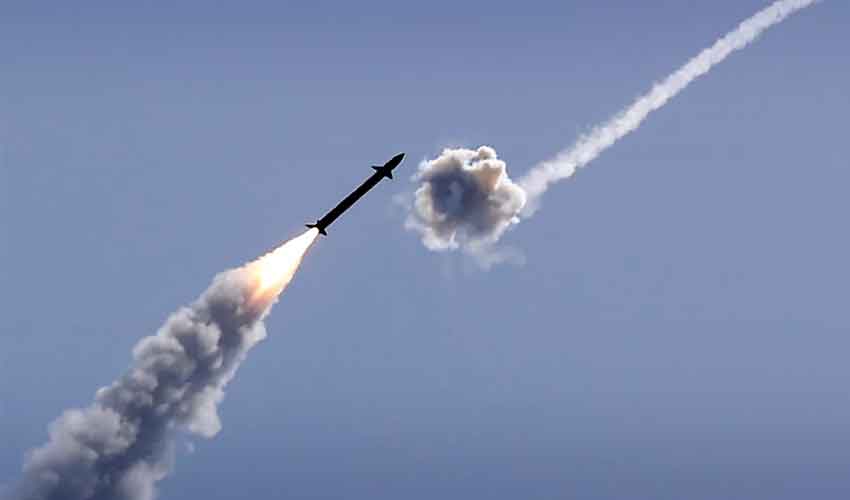





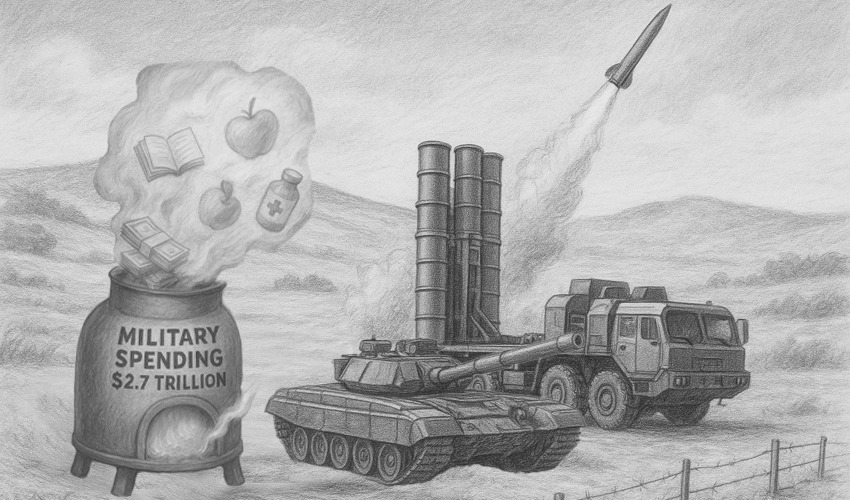
The record global military spending figure, recently shared by UN Secretary-General Antonio Guterres, is an obituary for all efforts toward peace. Shoving $2.7 trillion straight into the furnace of military expenditure is akin to making a mockery of every promise made under the Sustainable Development Goals. The price the world so willingly pays for the illusion of peace is terrifying, yet it is deemed necessary.
The UN chief rightly points out in his latest report on military expenditure how far the defense-obsessed world is lagging behind in sustainable development. The document reflects the global tendency to allocate more resources to waging war than building peace. The situation in developing and least-developed countries could have changed entirely had the amount been used for poverty reduction, promoting education, and providing healthcare.
The arithmetic looks absurd when the opportunity cost is taken into account. The gravity of the impact can be gauged by the fact that the cost of every bullet manufactured is roughly equivalent to a child’s daily school fee, while the money spent on each military parade can substantially finance a climate adaptation initiative. Moreover, just $300 billion could have wiped out extreme poverty from the world. Yet, countries instead chose to burn nine times that amount stockpiling arms and fighting wars. The worst part is that this military spending has continuously increased over the past decade. Ironically, defense budgets now stand at 750 times the regular UN budget.
The problem is not legitimate defense, but when states inflate threats to justify endless military build-ups. After all, every country has the right to defend its sovereignty and territory against aggressors, making defense spending unavoidable
Seeing all that money go up in smoke is deeply upsetting and an insult to fragile economies, whose resources and development opportunities could have benefited greatly from such investments. Nations must realize that the already-limping SDGs will now collapse if $2.7 trillion is set as the new military spending benchmark. Treading the same path will keep healthcare, education, climate adaptation, and poverty reduction permanently underfunded. In contrast, it would intensify the arms race, as more spending in one bloc automatically forces the other to “catch up”, and the result will be the complete opposite of desired peace and stability.
The problem is not legitimate defense, but when states inflate threats to justify endless military build-ups. After all, every country has the right to defend its sovereignty and territory against aggressors, making defense spending unavoidable. The recent Pakistan-India standoff and constant threats directed at Pakistan in the aftermath of that conflict are a prime example of times when the option of cutting defense budget is no longer on the table. That is not the case for most countries involved in the arms race. And in this race, everyone wants to be a winner and hence assert their dominance.
The consequences for the underprivileged will be even uglier. The recent suspension of USAID and its associated programs is a classic example of how donor countries filling up their arms depots can claim “budget constraints” when it comes to helping poor nations. Additionally, debt will grow heavier on developing states, which would have to either borrow more from global lenders or cut their own social budgets. Either way, the arms industry will continue to thrive, while societies languish at the losing end.
It is high time global powers realized that although war appears profitable and peace not, no amount spent on military equipment could buy real peace and security. At best, it fuels arms races and deepens mistrust, besides locking societies into a cycle of poverty and instability. Antonio Guterres’ word of caution must be heeded. The world must escape the paradox where security is bought at the expense of stability. Redirecting even a fraction of this obscene spending could change the course of humanity. An increasing number of saner voices are needed to dismantle the myth that peace and security only come from firepower. Nations must not forget that even the UN’s Universal Declaration of Human Rights as well as the Declaration on the Right to Peace adopted in 2016 recognize peace as a fundamental human right. It would be cruel to turn it into a luxury. Global leadership must recoil from the easy route and take the just one. Since $2.7 trillion spent in 2024 has not brought about peace, perhaps it is time the world admits that economic dignity is a better deterrent.