





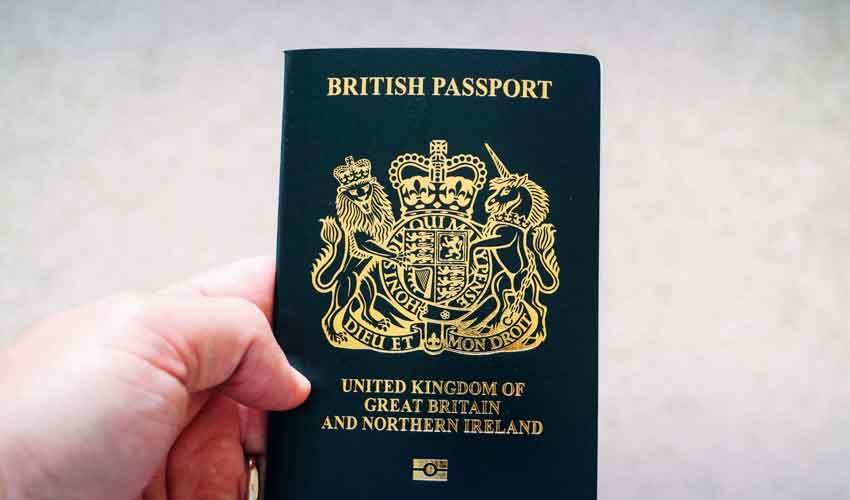
The UK government has temporarily suspended the requirement for dual nationals to obtain a costly Certificate of Entitlement to enter the country, offering relief to thousands of travellers ahead of new immigration rules.
Under the revised guidance issued by the Home Office, certain dual nationals may now use an expired British passport as proof of citizenship when boarding flights, ferries or trains to the UK.
What new rules say
The changes come into force on February 25 and were originally designed to require British dual nationals to present a valid British passport or a Certificate of Entitlement — costing £589 — attached to their foreign passport.
However, the Home Office has now clarified that carriers may, at their own discretion, accept an expired British passport as alternative documentation, alongside a valid foreign passport.
Additionally, a passport from a country listed under the UK’s Electronic Travel Authorization (ETA) scheme will also be accepted as a legal travel document.
Importantly, the final decision to allow or deny boarding rests with the management of the relevant airline, ferry or train operator. Transport operators risk fines if they board passengers without proper entry documentation.
Emergency travel documents
Individuals who previously held a British passport may also apply for an emergency travel document if they urgently need to enter the UK.
However, the Home Office noted that the flexibility does not assist those who have recently applied for a new British passport, as applicants are required to send their expired passport away during the renewal process.
On arrival at the UK border, Border Force will still assess travellers’ eligibility to enter and may conduct additional checks if required.
Stress, criticism over rule change
The new immigration rules, which were first flagged on the gov.uk website in October 2024 alongside the rollout of the Electronic Travel Authorization system, have caused confusion and distress among dual nationals.
In November, the government announced that British dual nationals would not be able to obtain an ETA using a foreign passport.
The requirement left many Britons living abroad, including children born overseas, scrambling to renew expired passports before travel. Some reportedly canceled trips to attend memorial services, weddings and visit seriously ill relatives.
The Liberal Democrats have called for a grace period to allow affected individuals time to renew passports.
Will Forster, the party’s immigration and asylum spokesperson, said the changes had left many dual nationals “in the lurch.”
“Whilst they sort out the chaos, the government should allow a grace period, as many dual nationals are in heartbreaking circumstances, unable to visit ill family members or attend weddings and funerals,” he said. He also urged the government to provide a more affordable alternative to the current system.
Legal, policy questions raised
Morgan Read, an immigration barrister at North Square Chambers, said there is nothing in the Immigration Act 1971 that requires a valid UK passport to prove British citizenship.
“It is well established that expired passports can be used to prove citizenship and identity,” he noted, pointing to official government guidance on right-to-work checks that allows expired British or Irish passports as proof.
The Home Office maintains that the new system aims to better distinguish British nationals from foreign nationals at border controls.
People with British and Irish dual nationality are not affected by the rule changes.
The policy shift comes as the UK tightens border controls through the new Electronic Travel Authorization system, which requires foreign nationals without residency rights to obtain approval before travel.
Many British citizens living in the European Union said they were caught off guard by the rule change. Some had taken dual nationality after Brexit and had not kept their British passports up to date, as they were able to travel in and out of the UK using EU passports.
With the new rules set to take effect on February 25, the temporary acceptance of expired British passports offers some breathing space — but uncertainty remains for many travellers navigating the updated requirements.