





The International Monetary Fund (IMF) review mission has departed Pakistan earlier than scheduled and arrived in Istanbul, Turkey, with remaining negotiations now shifting to a virtual format.
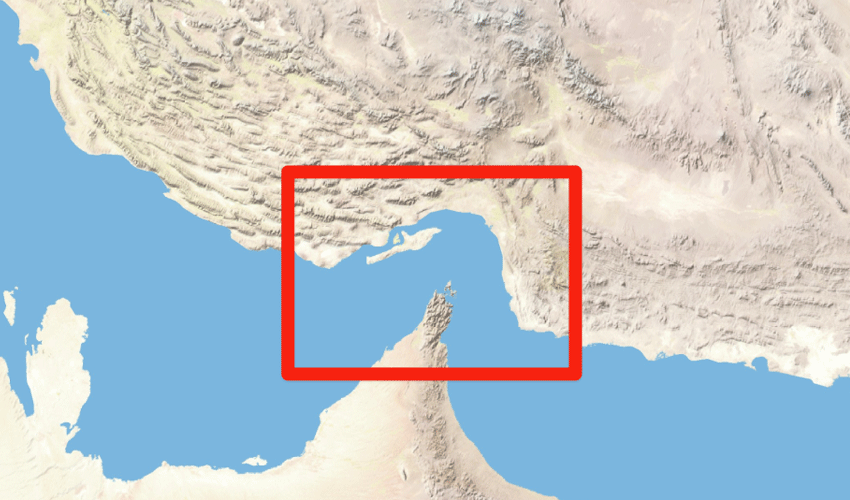
The move comes amid regional security concerns, though officials insist the economic review process remains on track.
According to sources, the IMF mission — which arrived in Pakistan on February 25 and was scheduled to stay until March 11 — cut its visit short due to the prevailing security situation.
The delegation is now continuing talks from Istanbul, while Pakistani officials confirmed that all remaining sessions will proceed online. Finance Ministry officials have not clarified whether virtual meetings will take place today.
Review led by Eva Petrova
The mission is being led by IMF Mission Chief Eva Petrova. Discussions focus on the third review of Pakistan’s Extended Fund Facility (EFF) programme and the second review of the Resilience and Sustainability Facility (RSF).
IMF Representative in Pakistan Mahir Benici confirmed that negotiations in both Karachi and Islamabad had formally begun and would continue virtually.
Petrova emphasized the importance of sustainable reforms, revenue enhancement, and increased spending in health and education sectors to maintain economic growth.
Key agenda items under discussion
Several meetings originally scheduled in person have either been shifted online or canceled.
A virtual session is planned on asset declarations of senior government officials, where lack of training within banks was highlighted as a challenge. Officials briefed the IMF that the State Bank of Pakistan and the Financial Monitoring Unit would provide training to address these gaps.
Meetings on information exchange with the Sovereign Wealth Fund, e-procurement, and the National Accountability Bureau (NAB) were canceled. Talks on ending preferential treatment for government companies were postponed.
However, key discussions remain on the agenda, including:
-
Refinancing schemes
-
Exim Bank operations
-
Capital market outlook
-
Anti-money laundering coordination
-
Risks of trade-based money laundering
-
Macroeconomic framework
-
Trade sector reforms
Economic indicators presented to IMF
During the initial phase of talks in Islamabad, Finance Minister Muhammad Aurangzeb briefed the delegation on recent improvements in economic indicators.
He stated that inflation fell to 5.2% in December 2025, while interest rates declined from 22% to 10.5%. The current account deficit was limited to $1.17 billion, and foreign exchange reserves surpassed $16 billion. Large-scale industrial production increased by 6%.
Aurangzeb also highlighted progress in privatization efforts, including developments related to Pakistan International Airlines (PIA), and ongoing reforms in tax and energy sectors.
Revenue shortfall
The Federal Board of Revenue (FBR) reported a tax shortfall of Rs329 billion for July to December 2025. Despite this, officials noted that the tax-to-GDP ratio had improved.
The government attributed the revenue gap to slower economic activity and declining inflation.
Sources said the IMF acknowledged reform progress but stressed the need for additional revenue measures. The mission is currently reviewing Pakistan’s request for the next $1.2 billion tranche under the programme.
Provincial tax revenues — particularly agricultural income taxes — along with external debt, financing arrangements, and future repayment obligations are also under review.
Focus on stability
Officials maintain that shifting the talks online will not disrupt the review process. The second phase of the third review continues as both sides work to ensure compliance with IMF conditions while navigating the current security environment.
With multiple high-level meetings scheduled virtually, Pakistan aims to secure the next tranche and sustain economic stability under the IMF programme.