




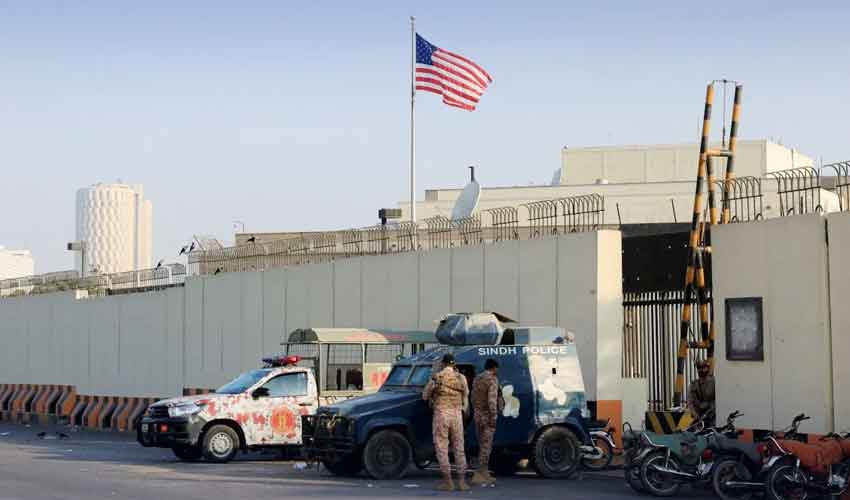
The United States has ordered non-emergency government personnel and their family members to leave its consulates in Karachi and Lahore, citing safety concerns.
However, officials confirmed that no change has been made to the operational status of the US Embassy in Islamabad.
In an important statement, the US Embassy in Islamabad said the US Department of State has directed non-emergency US government employees and the families of government personnel at the US Consulates in Karachi and Lahore to depart Pakistan.
The embassy clarified that no such directive has been issued for the US Embassy in Islamabad, which continues to operate as usual.
The consulates in Karachi and Lahore remain committed to acting in accordance with the statement issued by US authorities.
Pakistan: The State Department updated the Travel Advisory for Pakistan to reflect the ordered departure of non-emergency U.S. government personnel and family members of government personnel from U.S. Consulates Lahore and Karachi. Read the full advisory: https://t.co/Lz0vTwzQgs pic.twitter.com/ABO11FPWZp
— TravelGov (@TravelGov) March 4, 2026
Regional conflict and flight disruptions
The statement cited the current situation in the Middle East, particularly the escalation following hostilities between the United States and Iran that began on February 28.
Officials warned that there remains an ongoing threat of drone and missile attacks from Iran, which has also led to significant disruptions to commercial flights in the region.
Terrorism risks remain
The advisory also highlighted the continued risk of terrorist violence in Pakistan, including attacks by violent extremist groups.
According to the US Department of State, terrorist attacks most frequently occur in Balochistan and Khyber Pakhtunkhwa, including the former Federally Administered Tribal Areas (FATA). However, incidents have also taken place in major cities such as Karachi and Islamabad.
Also Read: US Embassy suspends all visa services in Pakistan
Authorities warned that terrorists may strike without warning, targeting locations such as transportation hubs, airports, trains, hotels, markets, shopping malls, schools, hospitals, places of worship, tourist sites, government buildings, and military or security installations.
Demonstrations and legal restrictions
The advisory also addressed the risks associated with public demonstrations in Pakistan. Local law requires a permit for protests or demonstrations, and being near such gatherings can attract scrutiny from security forces.
US officials warned that American citizens have previously been detained for participating in protests, and individuals may also face detention for posting content on social media considered critical of the Pakistani government, military, or officials.
The advisory further noted that internet and mobile phone service outages are common during protests.
Limits on US consular assistance
The statement also noted that the Pakistan government restricts travel by US government personnel working in the country. US officials often must travel with armed escorts and armored vehicles in certain areas, both for official and personal travel.
Additionally, the US government said it has limited ability to provide assistance to American citizens in Khyber Pakhtunkhwa, Balochistan, Azad Jammu and Kashmir, and most locations outside Islamabad, Lahore, and Karachi.
US personnel must also obtain special authorization from Pakistani authorities before traveling to most areas outside the three major cities.
Also Read: US closes embassies in Saudi Arabia, Kuwait
Movement restrictions can be imposed suddenly depending on local security conditions, and US employees are generally prohibited from attending large gatherings such as political rallies or religious events.
The embassy also warned that dual US-Pakistani citizens may face limited consular support if arrested or detained in Pakistan. Under Pakistani law, individuals with both nationalities are considered solely Pakistani citizens, which restricts the ability of US authorities to provide assistance.
High-risk travel zones in Pakistan
The advisory designated several areas as Level 4: Do Not Travel zones due to security risks.
Balochistan
US authorities strongly advised against travel to Balochistan, citing risks of terrorism and kidnapping. Extremist groups, including an active separatist movement, have conducted deadly attacks targeting civilians, foreign nationals, religious minorities, government facilities, and security forces.
Assassination attempts and kidnappings are also common in the region.
Khyber Pakhtunkhwa, including former FATA
Travel to Khyber Pakhtunkhwa is also discouraged due to terrorism and kidnapping risks. Active terrorist and insurgent groups frequently conduct attacks against civilians, government offices, non-governmental organizations, and security forces.
These groups have historically targeted both government officials and ordinary citizens, and have also attacked polio eradication teams and Pakistani security personnel.
Areas near Line of Control
The advisory further warned against travel to the vicinity of the Line of Control (LoC) due to terrorism risks and the potential for armed conflict.
Militant groups operate in the region, while India and Pakistan maintain a heavy military presence along both sides of the Kashmir border.
Also Read: US embassy in Riyadh hit by drones, minor fire reported
Officials noted that the only official crossing for non-citizens between Pakistan and India is the Wagah–Attari border in Punjab, and travelers should confirm the crossing status before planning a trip.
Travelers also require a valid Indian visa, and visa services are not available at the border.
Safety advice for travelers
For those who still choose to travel to Pakistan, the US government issued several safety recommendations. Travelers are advised to monitor local media for breaking news, remain alert in crowded areas and tourist locations, and avoid displaying signs of wealth such as expensive watches or jewellery.
Officials also recommended varying travel routes and schedules, avoiding demonstrations, and keeping travel documents updated and easily accessible.
Visitors should develop a communication plan with family or employers to confirm their safety regularly.
US citizens are encouraged to enroll in the Smart Traveler Enrollment Program (STEP) to receive security alerts and allow the embassy to contact them during emergencies.
Authorities also advised reviewing the Country Security Report for Pakistan, preparing an independent emergency evacuation plan, and purchasing travel insurance covering medical emergencies, evacuations, and trip cancellations.
Travelers are also urged to consult the Centers for Disease Control and Prevention (CDC) website for the latest health information related to Pakistan.
Earlier, the US had extended the closure of visa services at its embassies and consulates across Pakistan until Friday, March 6, citing the current security situation following nationwide protests.
The suspension comes after demonstrations erupted in several cities over the assassination of Iranian Supreme Leader Ayatollah Khamenei during Israeli and American attacks in Iran.
The US Embassy in Islamabad confirmed that all visa appointments have been canceled until March 6 due to security concerns.
Visa services have also been suspended at US consulates in Lahore and Karachi. According to the embassy, all scheduled appointments stand canceled until further notice, with fresh dates to be communicated soon.