





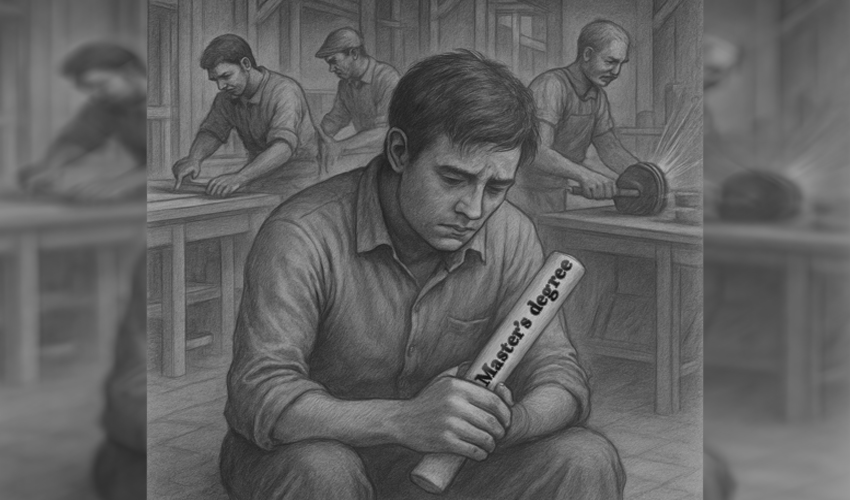
As the saying goes, “Don’t give them a fish, teach them how to fish.” In Pakistan, we have not even decided whether fishing is worth teaching. Education sans the right skill set is as ineffective and meaningless as sailing a boat without a sail. Unfortunately, millions of the country’s youth have boarded such boats, only to become so frustrated that giving up feels like the only option. This trend is not only disturbing but also dangerous. On this World Youth Skills Day, the state must intervene immediately to make the most of its young population, many of whom are often unjustly labeled as useless even with degrees and certificates in hand.
Pakistan has one of the highest youth population in the world, with around 65% of its people under the age of 30 years. Of the 80 million individuals aged between 15 and 29 years, many are ready to enter the job market but cannot make it despite years, if not decades, of education. While complaints about a saturated job market and unfair requirements are valid, one cannot ignore the importance of skill sets.
It is regrettable that despite being the backbone of any economy, skills are still not respected in Pakistan. They are often seen as something for those who could not make it academically. The presumed educated class treats them as a fallback plan instead of recognizing them as a front-line choice. Resultantly, parents try their level best to push their children into universities they cannot afford, for degrees they do not understand, in fields with no employment prospects. This very mindset is to be blamed for a generation caught between pride and poverty.
The country needs a national skills strategy that integrates modern technologies and responds to market needs. The Punjab government’s allocation of Rs26 billion for skills development and entrepreneurship is a welcome move. Consolidating all technical and vocational institutions under a single Skills Development and Entrepreneurship Department is a rare step that deserves appreciation. However, these efforts must not remain provincial showcases. They must be replicated and improved upon across the country.
Instead of just producing doctors who are not interested in practicing, engineers who do not want to build, and scientists who do not wish to experiment and innovate, focus must shift to encouraging youth to learn and develop skills in areas of their interest
Moreover, urgent steps are required to align education with economic opportunities. A country of 240 million adding 1.7 million people to its labor force each year cannot afford to keep its youth idle. Along with conventional education, they ought to be given direction and equipped with tools like practical training and mentorship so that they can effectively contribute to both national development and personal growth.
It is high time the authorities realized that enough time has been wasted talking about the youth and their future without even listening to them. Instead of just producing doctors who are not interested in practicing, engineers who do not want to build, and scientists who do not wish to experiment and innovate, focus must shift to encouraging youth to learn and develop skills in areas of their interest. It is only sensible to mark this World Youth Skills Day with a pledge to ensure the right to acquire skills and a future that is built on more than luck.








.gif)