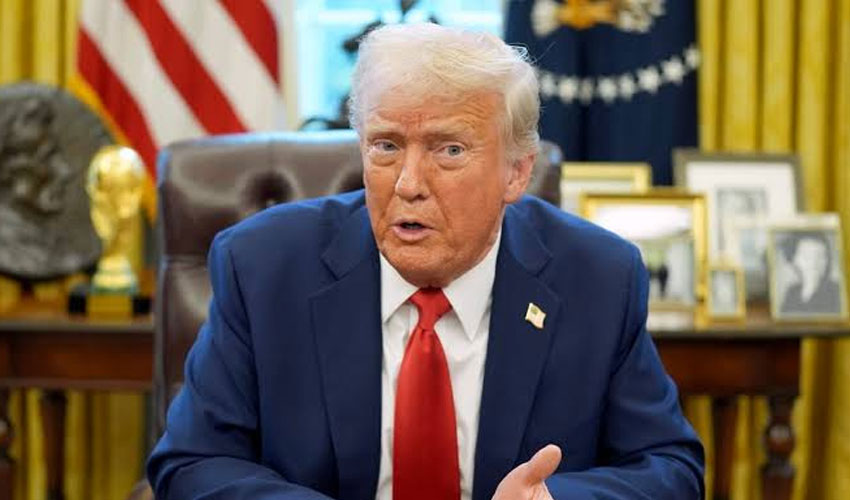







Donald Trump has said that several countries may send warships to help secure the Strait of Hormuz as tensions with Iran escalate.
The remarks come as the crucial waterway — responsible for transporting a major share of global energy supplies — remains largely disrupted amid the ongoing conflict.
Writing on the social platform Truth Social, Trump said “many countries” would dispatch naval forces to help keep the Strait of Hormuz open.
He suggested that nations heavily reliant on energy shipments through the route should contribute to the effort. Among those he mentioned were China, France, Japan, South Korea and the United Kingdom.
The US president said these countries could send warships “in conjunction with the United States of America” to ensure the passage remains open and secure.
The Strait of Hormuz — one of the world’s most important maritime chokepoints — carries roughly one-fifth of global oil and liquefied natural gas shipments.
The waterway has been effectively disrupted on the 15th day of the US and Israel’s war with Iran, raising concerns about global energy markets and shipping security.
Trump also claimed that US actions had “already destroyed 100% of Iran’s military capability,” although he acknowledged Tehran could still launch drones, mines or short-range missile attacks in the area.
He added that the US would continue targeting threats along the shoreline and Iranian vessels until the strait is “OPEN, SAFE, and FREE.”
Iran responds to US claims
Iranian officials pushed back against Trump’s statements.
Alireza Tangsiri, the naval chief of the Islamic Revolutionary Guard Corps, said the strait had not been fully closed militarily but was under Iranian control.
In a post on X, Tangsiri criticized Washington’s claims, saying the United States had falsely declared Iran’s naval capabilities destroyed and was now seeking help from other countries.
Iran’s Foreign Minister Abbas Araghchi clarified that the strait was closed only to “tankers and ships of enemies and their allies,” rather than all vessels.
At the same time, Mohsen Rezaee, a member of Iran’s Expediency Discernment Council, stated that no American ship had the right to enter the Gulf.
Despite the tensions, some ships have continued to pass through the waterway.
Select tankers allowed through strait
Two Indian-flagged tankers carrying liquefied petroleum gas crossed the strait safely on Saturday morning, according to Rajesh Kumar Sinha of India’s Ministry of Ports, Shipping and Waterways.
Iran’s ambassador to India, Mohammad Fathali, confirmed that Tehran granted Indian vessels an exemption following talks between Narendra Modi and Iranian President Masoud Pezeshkian.
A Turkish-owned ship was also permitted to pass earlier in the week after direct negotiations between Turkey and Iran. However, 14 additional Turkish vessels remain awaiting clearance.
US previously hesitant on escort operations
Earlier, Chris Wright, the US energy secretary, told CNBC that the United States was not ready to escort ships directly through the strait.
However, Trump later emphasized that countries benefiting from oil shipments through the route should take responsibility for its protection, with US coordination and support.
Analysts warn that even the threat to shipping routes in the Strait of Hormuz could have significant economic consequences.
According to the Center for Strategic and International Studies, the disruption could affect global food security because liquefied natural gas shipped through the strait is a key ingredient in nitrogen-based fertilisers used for staple crops.
The situation has already prompted emergency measures in several countries.
For example, India has invoked special powers to protect 333 million households that depend on LPG, while Tom Fletcher, the UN’s humanitarian chief, warned that millions of people could face risks if humanitarian cargo cannot safely pass through the waterway.
The conflict between the United States, Israel and Iran has intensified since air attacks began on February 28.
More than 2,000 people have reportedly been killed, mostly in Iran, according to government and state media reports.
Meanwhile, Trump has also warned of further strikes on Iran’s Kharg Island oil export hub, saying the US might hit the site again if necessary.