




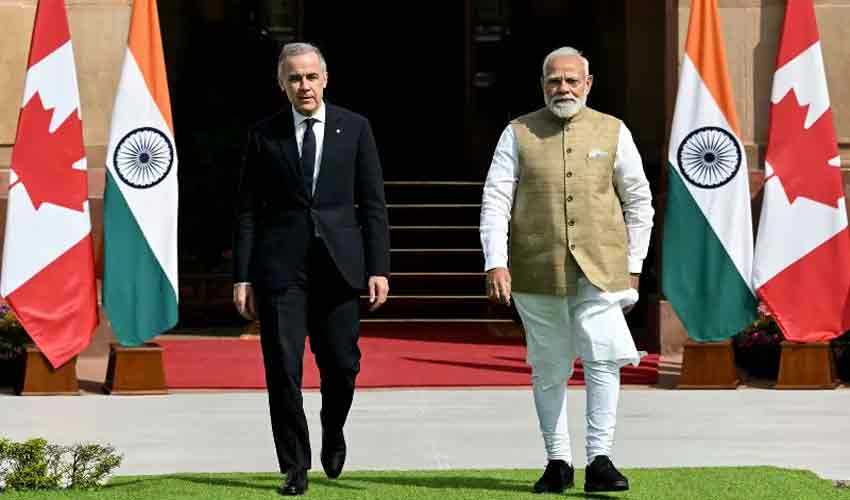
India and Canada on Monday unveiled a series of agreements spanning critical minerals, clean technology, and nuclear energy, marking a significant step toward repairing relations that had deteriorated sharply in recent years.
Speaking in New Delhi alongside Canadian Prime Minister Mark Carney, Indian Prime Minister Narendra Modi described the renewed engagement as a turning point. “Our ties have gained new energy, mutual trust, and positivity,” he said.
The two countries announced a long-term uranium supply agreement to support India’s expanding nuclear power ambitions, alongside cooperation on small modular reactors and advanced nuclear technologies. Canada also positioned itself as a reliable supplier of liquefied natural gas from its west coast, while both nations pledged closer collaboration in renewable energy development.
Carney characterized the agreements as the foundation of a broader strategic energy partnership, including a uranium supply arrangement valued at approximately $1.9 billion. He emphasized Canada’s role as a key partner in meeting India’s demand for critical minerals essential for manufacturing, clean technologies, and nuclear power generation.
The leaders also reaffirmed their commitment to concluding a Comprehensive Economic Partnership Agreement, with a shared goal of boosting bilateral trade to $50 billion. Modi said the deal would create investment opportunities and generate employment in both countries, while Carney expressed confidence that negotiations could conclude by year’s end.
Beyond economic cooperation, the two sides agreed to renew security collaboration through a new defence partnership. Canadian pension and wealth funds have already invested roughly $73 billion in India, underscoring deepening financial ties.
Relations between the countries had effectively collapsed in 2023 after Canada accused India of involvement in the killing of Sikh activist Hardeep Singh Nijjar—allegations New Delhi denied. The dispute led to reciprocal diplomatic expulsions in 2024. Tensions began easing after Carney assumed office in 2025, with diplomatic representation subsequently restored.
Carney’s visit to India forms part of a broader effort to diversify Canada’s trade relationships beyond the United States. With more than three-quarters of Canadian exports historically destined for the US, Ottawa has sought new economic partnerships amid ongoing uncertainty in global trade policy.
Following his India visit, Carney is scheduled to travel to Australia and Japan as part of Canada’s expanding Indo-Pacific engagement strategy.