






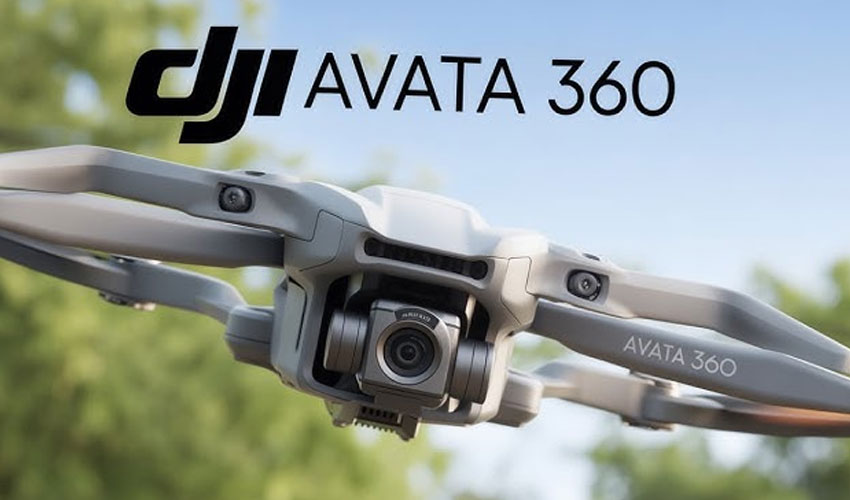
Chinese drone maker DJI has officially confirmed the launch of its next drone, widely believed to be the DJI Avata 360.
The company announced a launch event scheduled for March 26 at 12 PM GMT, accompanied by the teaser slogan “Above It All, See It All.” The announcement has fueled expectations that the upcoming drone will feature a 360-degree aerial camera system.
DJI’s teaser image shows a prominent curved lens element, strongly suggesting a camera designed to capture a full panoramic view.
Although the company has not revealed official specifications yet, early leaks and industry reports indicate that the drone could introduce a new direction for DJI’s first-person-view (FPV) drone lineup.
The launch event is expected to clarify how the device fits into DJI’s growing range of consumer drones.
If the rumours are accurate, the DJI Avata 360 could combine FPV flying with a dual-lens 360-degree camera system capable of recording everything around the drone simultaneously.
This feature would allow creators to reframe shots after filming, similar to how 360-degree action cameras are used.
For example, creators could capture the entire environment during flight and later choose the best camera angle during editing. DJI already applies similar technology in products like the DJI Osmo 360.
Design expected to build on Avata 2
Reports suggest the drone will retain the compact design of the DJI Avata 2.
The expected cinewhoop-style frame with enclosed propellers is designed to make FPV flying safer when navigating tight spaces or obstacles.
This design has already become popular among creators who want cinematic aerial footage while maintaining precise control during flight.
Possible competition with Insta360’s drone plans
If confirmed, DJI’s new drone may directly compete with the Antigravity A1, a drone developed by the Antigravity brand incubated by Insta360.
Unlike traditional drones that capture footage from a fixed direction, these devices record full spherical video, allowing users to select framing later in post-production.
The concept allows pilots to focus on flying while the camera records the entire surroundings.
Industry reports suggest DJI could introduce the Avata 360 with competitive pricing to challenge rivals entering the 360-degree drone segment.
Earlier this year, the Antigravity drone reportedly received a price cut, a move seen by some analysts as preparation for DJI’s entry into the category.
DJI has previously used similar strategies to strengthen its position in the drone market. For example, when the company launched the DJI Flip, it priced the drone to compete directly with the HoverAir X1, a compact autonomous flying camera.
If the same approach is used again, the Avata 360 could become a more affordable option for creators interested in 360-degree aerial footage.









.jpg)