




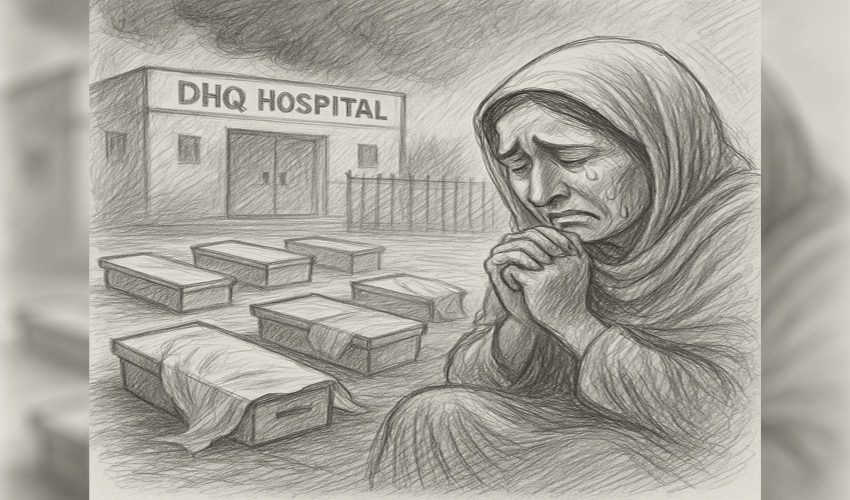
The smallest coffins are indeed the heaviest. The recent deaths of 20 children in Pakpattan’s District Headquarters Hospital have left a deep wound. At the same time, the tragic incident has raised many questions, some of which are valid. The formation of an external inquiry committee is a welcome step. This misfortune should not have happened in the first place, but now that it has, the small white shrouds demand more than just investigation.
The deaths were reported in the third week of June, and most of the deceased were newborns and infants. The matter was highlighted when five infants died in a single day on June 19. This prompted hospital authorities to launch an internal probe to find out what went wrong. The inquiry revealed that many of the children were underweight and in critical condition upon arrival, having been referred from various local private hospitals. However, families alleged a shortage of oxygen and the medical staff’s negligence. Official statements ruled out the claims and suggested that the babies were already beyond recovery. The story was hard to believe, which is why an external inquiry was ordered, whose report is expected soon.
Recent crackdown on these private healthcare centers does bring some comfort, but concrete steps are required to ensure the practice is stopped for good. Playing with human lives to mint money cannot be allowed under any circumstances
Also, the complicity of private healthcare facilities in the incident cannot be overlooked. It is appalling that a majority of the children were referred by them to the DHQ because a mortality on the premises stains their ‘clean’ record. It is common for private clinics and hospitals to admit patients initially, just to bill the attendants before referring the sick to public hospitals. The recent crackdown on these private healthcare centers does bring some comfort, but concrete steps are required to ensure the practice is stopped for good. Playing with human lives to mint money cannot be allowed under any circumstances.
Meanwhile, the way the issue has been used to settle the score is inappropriate and uncalled for. It would have been better had the words coming from all sides offered comfort to the grieving families instead. All tragedies must be kept free from political point-scoring, especially when the basis for criticism is mere rumors or allegations.
That being said, Punjab Minister for Health Khawaja Imran Nazir was right in pointing out that infant mortality due to factors like malnutrition and premature births is not unusual anywhere in the world. However, such statements cannot soothe the pain of the ill-fated parents. The provincial authorities too deserve acknowledgement for launching yet another inquiry and taking a position that no negligence or misconduct, if proven, will be forgiven.
Meanwhile, the bitter truth remains that lives were lost. Now it is incumbent upon the government to ensure that deaths at Pakpattan hospital are not buried. Although it may be too soon to lay blame, it is not too soon to start fixing what is broken. And the reality is that something certainly needs fixing. Hospitals are expected to save patients no matter how critical, so they must be well-equipped to meet the expectation. Regardless of the findings of the committee, healthcare authorities must ensure a stronger, faster, and more prepared system so that the next critically ill child brought in has a good fighting chance.