






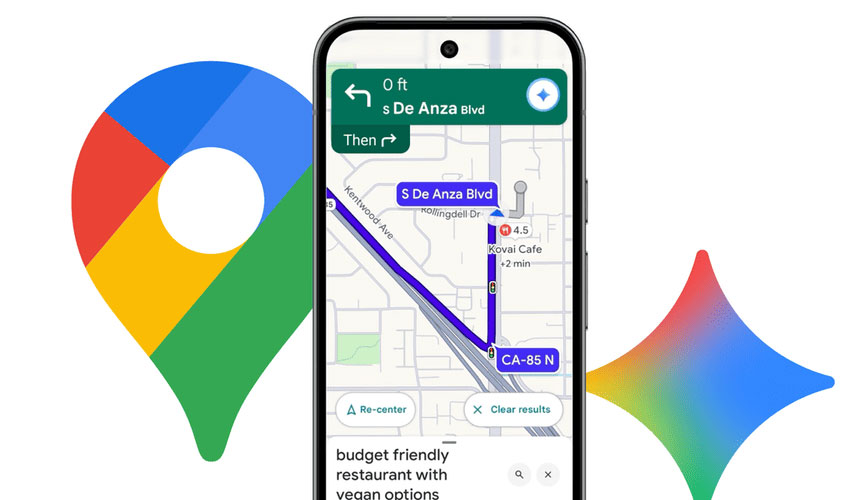
Google has rolled out a major artificial intelligence upgrade to Google Maps, introducing a new chatbot-style feature called “Ask Maps.”
The update, powered by Gemini, will allow users to ask complex questions about nearby places while a new Immersive Navigation feature offers a detailed 3D view of roads, buildings, and landmarks.
The new Ask Maps button will appear below the search bar in Google Maps once the feature becomes available.
According to Google, the feature is designed to create a conversational experience, allowing users to ask real-world questions that traditional map searches could not answer before.
Tapping the button opens a chat-style interface similar to other Gemini tools. Users can ask questions in natural language instead of typing simple search queries.
Examples include:
-
“My phone is dying — where can I charge it without waiting in a long line for coffee?”
-
“Is there a public tennis court with lights where I can play tonight?”
The AI assistant will then provide relevant location suggestions based on the query.
AI can help plan trips
Beyond simple recommendations, Ask Maps can also help users plan trips or build travel itineraries.
The feature may provide directions, estimated travel times, and suggestions on places worth exploring. It can also highlight lesser-known attractions or recommend the best route to reach a destination.
In some cases, the system may offer tips gathered from user experiences, including advice on discovering hidden gems or finding free tickets to attractions.
Ask Maps uses a person’s Google Maps search history and saved locations to tailor responses.
For example, if a user frequently searches for plant-based restaurants, the system may prioritize vegan dining options when recommending places to eat.
Each suggested location will include several details such as:
-
Photos of the place
-
AI-generated summaries of user reviews
-
Opening hours
-
Options to save the location or get directions
Users can also share the recommendations with friends or family before deciding where to go.
Immersive navigation
Alongside Ask Maps, Google has also introduced Immersive Navigation, which the company describes as the largest update to Google Maps in more than a decade.
This feature provides a detailed 3D visualization of the environment, including buildings, bridges, and terrain surrounding the route.
The experience resembles a driving simulation, giving users a clearer sense of the road ahead.
One notable feature involves turns around large structures.
If a road curves behind a building, the structure automatically becomes translucent, allowing drivers to see the road and upcoming turns more clearly.
The navigation system also highlights key road elements such as:
-
Driving lanes
-
Crosswalks
-
Traffic lights
-
Stop signs
These visual cues are designed to make turns and merges easier to follow.
Powered by Gemini and street view data
Google said Immersive Navigation was built using Gemini AI models, aerial photography, and imagery from Google Street View.
The company has also updated voice navigation to sound more natural. For instance, it may provide directions like: “Go past this exit and take the next one for Illinois 43 South.”
The update also introduces new features designed to improve trip planning.
An enhanced Street View experience will allow users to check for parking spots near their destination before starting a trip.
The system can also show the building entrance and indicate which side of the road users should park on.
Google Maps will additionally notify users about alternate routes and their potential consequences, while providing real-time alerts about disruptions such as crashes or road closures.
Google says Ask Maps is beginning to roll out to mobile users in the United States and India before expanding to desktop versions.
The rollout is expected to be gradual, and the feature may not appear immediately for all users.
Meanwhile, Immersive Navigation will initially be available only to users in the United States.
In the coming months, Google plans to expand the feature to eligible users across iOS, Android, Apple CarPlay, Android Auto, and vehicles with Google built-in systems.