





The United States is sending additional Marines and warships to the Middle East as tensions with Iran intensify and attacks around the strategic Strait of Hormuz continue.
US officials said the Pentagon approved the deployment after a request from US Central Command, signaling that Washington is expanding its military posture in the region rather than winding down operations.
According to three US officials, Defense Secretary Pete Hegseth approved a request from US Central Command (Centcom) to dispatch an amphibious ready group and a Marine expeditionary unit to the Middle East.
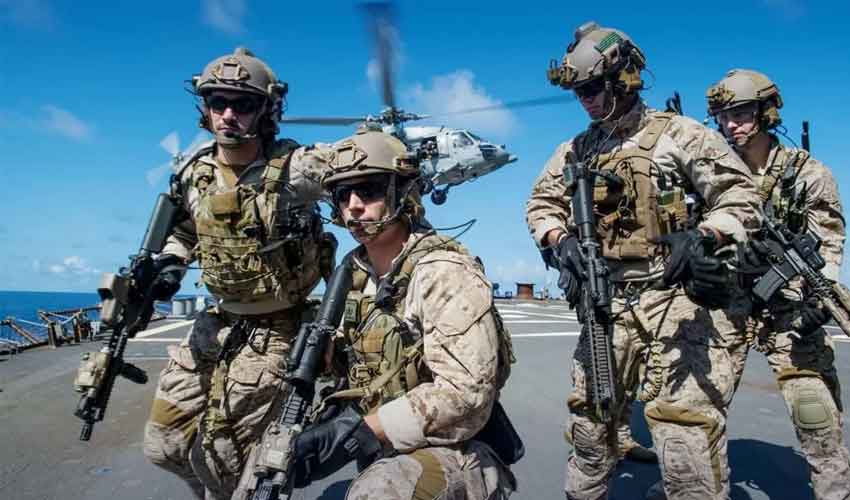
Such a unit typically consists of several warships and around 5,000 Marines and sailors, providing commanders with rapid-response capabilities in crisis situations.
Two officials said the Japan-based USS Tripoli, an amphibious assault ship, and its attached Marines are already heading toward the Middle East.
Marines are already operating in the region as part of ongoing military operations related to the conflict with Iran.
Amphibious strike group includes advanced aircraft
The deployment includes elements of the 31st Marine Expeditionary Unit, the Marine Corps’ only permanently forward-deployed MEU based in Japan. The unit is equipped with F-35B Lightning II fighter jets and MV-22B Osprey aircraft, giving it strong air support and rapid mobility capabilities.
According to US officials cited by NBC News and The Wall Street Journal, the deployment includes about 2,500 Marines and 2,500 sailors, forming part of an Amphibious Ready Group/Marine Expeditionary Unit (ARG/MEU).
Also Read: US bombs Iran’s Kharg Island, Trump warns of oil targets next
These units are trained for rapid crisis response missions, including evacuating civilians from dangerous areas, protecting US embassies, and securing locations for follow-on military operations by other forces such as special operations units.
USS Tripoli moving toward Middle East
The amphibious ready group is led by the USS Tripoli and includes the USS San Diego and USS New Orleans. The ships had recently been operating in the Philippine Sea but are now moving west toward the Middle East.
Officials said the voyage from Japan to the region typically takes around two weeks. The request for reinforcements was made by US Central Command, which oversees American military operations in the Middle East.
The reinforcement suggests Washington is not planning to scale back its war against Iran anytime soon, despite repeatedly claiming major operational successes. US officials have said those successes include killing Iran’s Supreme Leader Ayatollah Ali Khamenei and sinking 60 Iranian naval vessels.
According to reports, more than 1,400 Iranians have been killed since February 28, when the conflict began following joint US and Israeli strikes on Iran.
The Pentagon has also said it has struck around 6,000 Iranian targets during the first two weeks of the conflict.
US casualties rising as conflict expands
The war has proven increasingly unpopular with the American public, even before confirmed US casualties reached double digits. At least 150 American personnel have been wounded so far.
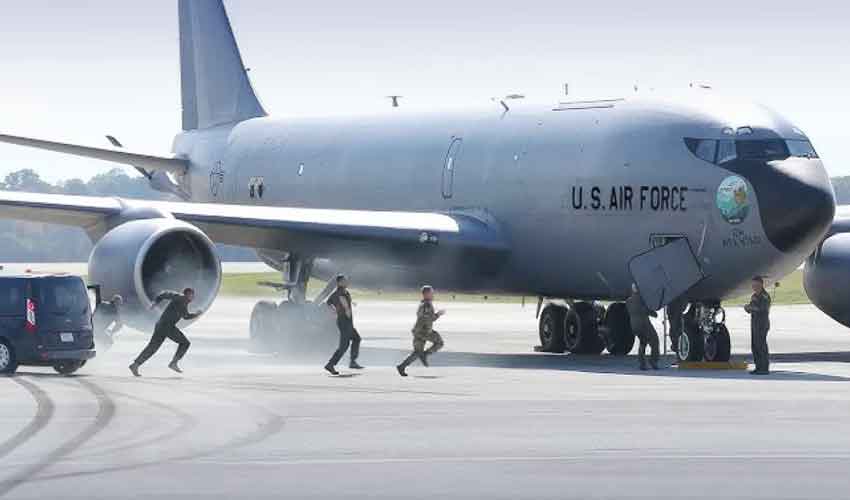
On Friday, the US military announced that all six soldiers aboard a KC-135 refuelling aircraft that crashed in western Iraq were killed. US Central Command said the aircraft was lost on March 12 while flying over friendly airspace during Operation Epic Fury.
“The circumstances of the incident are under investigation,” Centcom wrote on X. It added that the crash was not caused by hostile fire or friendly fire.
Also Read: US defence chief claims Iran missile industry destroyed
The identities of the six service members are being withheld until 24 hours after their families have been notified. Their deaths bring the total number of US personnel killed since February 28 to 13.
During a press briefing in Washington on Friday, Hegseth acknowledged the difficulties of the conflict. “War is hell, war is chaos,” he told reporters.
When pressed for details about US casualties and where they occurred, Hegseth turned to Chairman of the Joint Chiefs of Staff General Dan Caine.
Caine said casualties had occurred in Kuwait, Jordan and across the southern flank of the region, many from one-way attack strikes.
However, he did not provide specific numbers.
Hegseth later said the Pentagon was not specifying how many troops were killed in action (KIA) or wounded in action (WIA), adding that about 90% of injured personnel had returned to duty.
The explanation created confusion about the exact number of casualties.
Iran claims higher US death toll
Iran has claimed hundreds of American troops have been killed in its attacks on US assets in the Gulf region. However, Tehran has not provided evidence to support those claims.
Meanwhile, US officials cited by the Washington Post and South Korean media said parts of a missile defense system currently deployed in South Korea are being relocated to the Middle East.
Also Read: Trump says he thinks Iran's new supreme leader is alive but 'damaged'
The move is intended to strengthen defensive capabilities in the region as tensions with Iran escalate.
Trump warned earlier this week that Iran would be hit “very hard” in the coming days, adding that the war would end “when I feel it in my bones.”
Hegseth also signaled a tough stance, saying the US military would show “no mercy for our enemies.”