




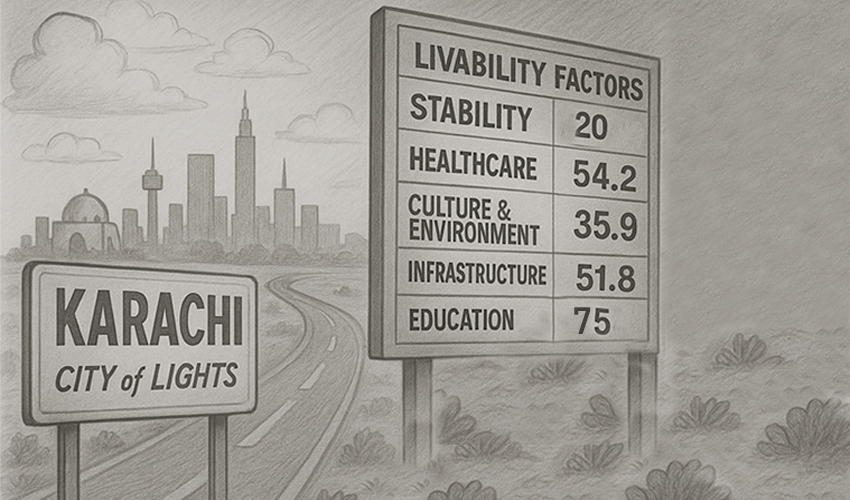
The latest Global Liveability Index report did not come as a surprise. Most of Karachi’s residents already know that the city is unliveable, and continues to sink deeper into civic dysfunction year after year. This time the Index ranks it 170th, making it the fourth-worst city on the planet to live in. Still, it remains shameful that despite being the city of lights and dreams, Karachi is repeatedly ranked this low by international observers.
The Index ranks cities based on five key factors: stability, healthcare, culture and environment, education, and infrastructure. This year, the stability score of the country’s largest metropolis remained just 20/100, showing how dysfunctional it has remained owing to street crimes, gang violence, extortion, and land mafia activities, among other issues. Despite having some excellent private hospitals, it managed to score just 54.2 in healthcare, which hints at how underfunded and unequal the healthcare system remains.
Moreover, infrastructure at 51.8 and culture & environment at 35.9 are barely tolerable for a megacity that has been struggling with water supply, unplanned construction and a complete absence of modern urban transport, with the exception of one BRT service. The best the city had to offer was education with 75 points, a decent score largely attributed to the private education sector.
The most tragic aspect, perhaps, is how this decline has become normalized over the past two decades or so. Karachi has been in a civic freefall for far too long. The bar has been lowered so often that basic services like clean drinking water, reliable drainage, and uninterrupted power are now considered luxuries rather than rights.
Nonetheless, the city continues to accommodate more than 20 million people, far more than its current capacity, given its resources. Expecting more without proper planning and adequate resource allocation would be imprudent. Serious efforts must be made to ensure the city does not appear on such lists in the future.
For this, the foremost step would be to fix the fractured governance model. Infrastructure needs to be not just planned and built but also maintained. The practice of laying one road while leaving another in disrepair must end. It is convenient to leave the city on autopilot for a little longer, but that would be a grave mistake.
Policymakers must wake up to the crisis unfolding and pay heed to the warnings before the national trading hub turns into a national liability. The time to act passed long ago, but recovery is still within reach, for now
The situation requires prompt and collective action without delay. Roles of the provincial government, multiple civic agencies, and the federation ought to be redefined and respected, with zero tolerance for bureaucratic excesses. Otherwise, the administrative quagmire will remain, where no one authority will truly be in charge and yet all will claim jurisdiction or pass the buck, depending on the situation.
By showing Pakistan the mirror once more, the Global Liveability Index report again implores authorities to solve Karachi’s longstanding problems. Policymakers must wake up to the crisis unfolding and pay heed to the warnings before the national trading hub turns into a national liability. The time to act passed long ago, but recovery is still within reach, for now.