




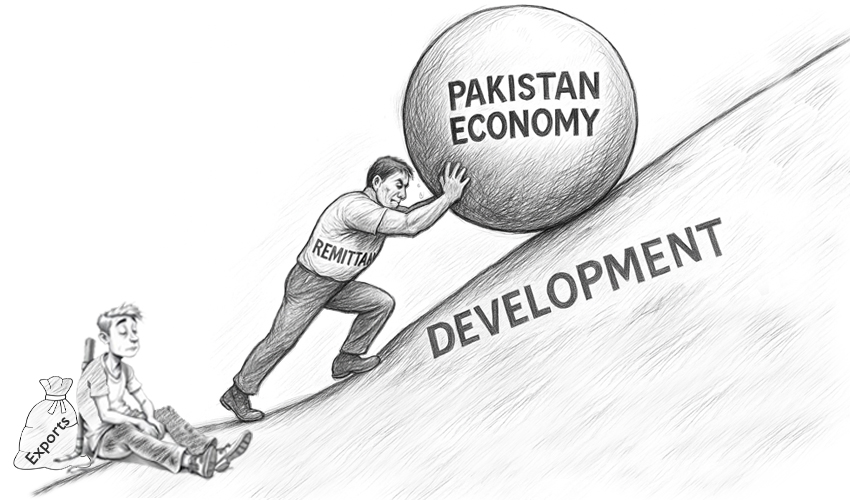
The latest remittance figures have come as a blessing in disguise, especially at a time when the economy is handling too many pressures at once. The August inflows of $3.1 billion in workers’ remittances are nothing less than a lifeline that overseas Pakistanis continue to provide. Nearly $737 million of the total came from Pakistani diaspora in Saudi Arabia alone, which is a promising development. Together with the UAE, UK and US, these corridors have built a steady cushion that shields the economy from immediate shocks. However, the state must stop treating remittances as easy money; instead, turn this ‘consumption cushion’ into a development driver through investment to build lasting economic strength.
According to SBP data, Pakistan has received $6.4 billion in the first two months of the new fiscal year. This 7 percent increase from last year brings great comfort, especially when external accounts remain stretched. There is also an important counterweight in these numbers. While exporters complain of an artificial interbank rate and that a portion of remittances comes through the hundi market, the official data shows that formal channels remain strong and trusted despite distortions.
In addition, the State Bank figures offer two clear signals. First, the pipeline from the Gulf remains intact, with overseas Pakistanis sending amounts that dwarf most other sources of foreign exchange. Ironically, last fiscal year’s record $38.3 billion inflows were more than the IMF bailout itself, proving that remittances are the main current sustaining the economy.
Second, the concentration of inflows is striking, with Saudi Arabia and the UAE together making up nearly half the pie. The recent Bureau of Emigration and Overseas Employment (BEOE) report showed a significant growth in labor migration in the first half of 2025, especially to countries such as Saudi Arabia and Qatar.
This is something to celebrate, but it also implies that any slowdown in the Gulf region could hit Pakistan’s reserves hard. Although the labor market there continues to absorb Pakistani workers, overreliance on a narrow set of host countries is imprudent. While inflows from the UK and the US do provide some diversification, they are not large enough to offset a Gulf shock.
That being said, the year-on-year increase of 6.6 percent last month also deserves attention, considering uneven global growth and rising inflation in host economies. This growth provides the economy with much-needed space to manage the current account without resorting immediately to emergency borrowing. The government must realize that despite being a stabilizer, remittances are not guaranteed to hold indefinitely.
It is high time for the state to stop using the remittance cushion merely to pay bills, and start treating it as a potential investment that feeds production and exports
It is reassuring that inflows are keeping the economy on its feet, but more is required to set it in motion. The state must consider launching diaspora bonds, regulated housing projects, and remittance-backed SME funds to turn private transfers into collective gains. Digital banking products and tax incentives can also encourage savings and business creation among both remitters and recipients. Moreover, wooing overseas Pakistanis through equity stakes in industrial or energy projects may be worthwhile, as it not only links them directly to the country’s future but also builds a safety net for them.
It is high time for the state to stop using the remittance cushion merely to pay bills, and start treating it as a potential investment that feeds production and exports. Policymakers across the board must put their heads together to find ways to break away from the cycle of debt and dependency if they truly intend to build a strong engine of growth.