





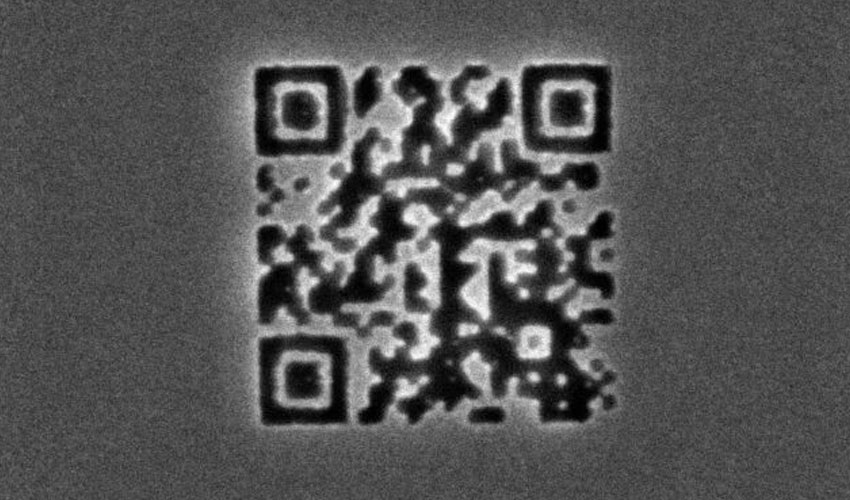
In a remarkable feat of nanotechnology, researchers in Austria have created the world’s smallest QR code — so small it cannot be seen with the naked eye.
The microscopic barcode, smaller than some bacterial cells, has officially earned a Guinness World Record.
The record-breaking matrix barcode covers just 1.977 square micrometers, making it smaller than certain bacteria and even some air pollutant particles.
So tiny is the code that a regular smartphone camera cannot scan it. In fact, reading it requires equipment comparable to an electron microscope.
On 3 December 2025, the team of seven scientists behind the innovation was awarded a Guinness World Record for their achievement.
Their creation measures roughly one-third the size of the previous record holder.
The project was led by researchers at Vienna University of Technology (TU Wien) in collaboration with data storage technology company Cerabyte.
Materials scientist Paul Mayrhofer explained the scale of the achievement.
“The structure we have created here is so fine that it cannot be seen with optical microscopes at all,” he said.
However, he noted that creating microscopic structures alone is not unusual in modern nanotechnology. The real challenge was ensuring the code remained stable and readable.
Invisible yet fully functional
Despite its minuscule dimensions, the QR (Quick Response) code works.
The readout process for the Guinness World Record was conducted in the presence of witnesses and independently verified by the University of Vienna.
This confirmation ensured that the code was not only record-breaking in size but also fully scannable and functional.
How scientists made it so small
The key to shrinking the QR code lay in printing it onto a thin ceramic film. This material is typically used for coating high-performance cutting tools.
Using focused ion beams, researchers carved the QR pattern into the ceramic surface. Each pixel measured just 49 nanometers in size.
That is approximately ten times smaller than the wavelength of visible light — which explains why the code is completely invisible to the human eye.
According to TU Wien materials scientist Alexander Kirnbauer, the team drew inspiration from history.
“With ceramic storage media, we are pursuing a similar approach to that of ancient cultures, whose inscriptions we can still read today,” he said.
The idea is to engrave data into stable, inert materials capable of withstanding the passage of time while remaining accessible to future generations.
Beyond setting a record, the researchers see broader potential in ceramic-based data storage.
They hope to develop other miniature storage formats that are highly durable and potentially more environmentally friendly than current options.
In fact, the team estimates that using their method, more than 2 terabytes of data could theoretically be stored on a single A4-sized piece of paper.