





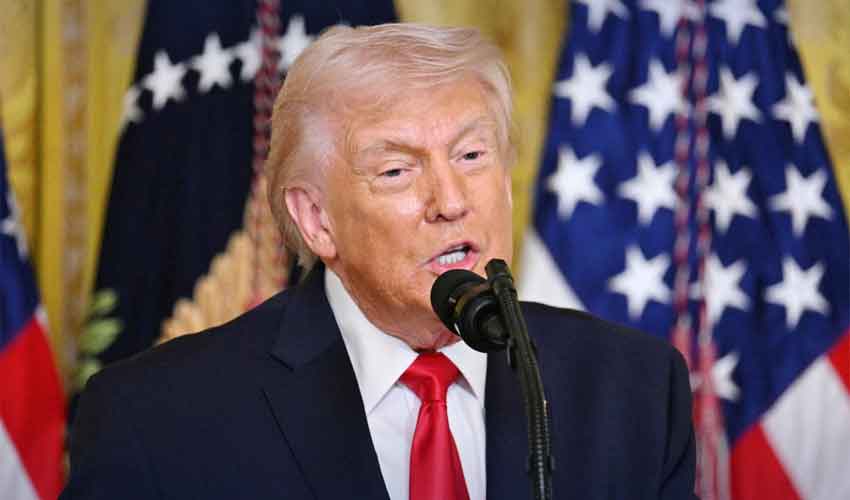
US President Donald Trump has renewed threats of major strikes on Iran’s infrastructure, even as he claims progress in ongoing talks. The situation highlights rising tensions amid a fragile diplomatic effort.
US President Donald Trump said “great progress” has been made in talks with Iran to end military operations.
However, he warned that if a deal is not reached soon and the Strait of Hormuz is not reopened, the US could escalate its offensive significantly.
In a social media post, Trump threatened to “blow up and completely obliterate” Iran’s electric generating plants, oil wells, Kharg Island, and possibly desalination plants supplying water.
Civilian infrastructure among targets
Trump’s latest remarks expanded earlier threats to include water desalination facilities, which are critical for millions of people. Experts have warned that targeting such civilian infrastructure would violate international law, which prohibits attacks on civilian sites.
The US president had initially issued a 48-hour deadline for Iran to reopen the Strait of Hormuz, later extending it multiple times, with the current deadline set for April 6.
Also Read: Iran calls US peace proposals 'unrealistic'; oil price rises
Over the past week, Trump’s messaging has alternated between optimism about a potential deal and threats of further military action. He suggested the US could seize Iran’s Kharg Island, a key oil export hub, although he acknowledged such a move would require a sustained military presence.
Reports indicate that Washington is also considering deploying troops to secure Iran’s enriched uranium stockpiles located at facilities in Isfahan and Natanz.
Indirect talks continue through mediators
Despite ongoing tensions, the US and Iran remain in indirect communication through intermediaries, including Pakistan, Turkey, and Egypt. However, both sides appear far apart in their positions, with no direct negotiations confirmed.
Iran has acknowledged receiving a 15-point proposal from the US but described it as “excessive, unrealistic and unreasonable.”
Tehran has demanded guarantees against future US attacks, compensation for damages, and recognition of its control over traffic in the Strait of Hormuz.
Pakistan recently hosted foreign ministers from Saudi Arabia, Egypt, and Turkey in Islamabad to discuss ways to end the conflict. However, officials from the US, Iran, and Israel were not present, and the talks concluded without any formal announcement.
Claims of regime change
Trump has claimed that the US has achieved “regime change” in Iran due to the killing of several senior leaders. He also referred to dealing with a “new, and more reasonable, regime” in Tehran.
However, analysts suggest that the rise of Mojtaba Khamenei, considered a hardliner close to the Revolutionary Guard, indicates a tougher stance rather than moderation. There is no public evidence supporting claims of a new government in Iran.
Rubio cautious on US contacts
US Secretary of State Marco Rubio declined to disclose who Washington is communicating with inside Iran. He said revealing such details could put those individuals at risk, adding that it remains unclear who holds real power within the Iranian leadership.
On the ground, the conflict continues to escalate with no clear signs of de-escalation. Iran has launched attacks on regional targets, including a power and desalination plant in Kuwait, killing one worker and injuring others.
Also Read: Trump ‘pretty sure’ of Iran deal amid ongoing talks in Pakistan
Saudi Arabia intercepted missiles targeting its Eastern province, while the UAE also intercepted incoming threats.
Israel reported strikes near its nuclear research center and confirmed intercepting drones launched from Yemen by Iran-backed Houthi rebels.
Meanwhile, Israeli and US forces have continued strikes inside Iran.
The ongoing attacks and regional escalation have complicated diplomatic efforts. The UAE has signaled it wants Iran disarmed as part of any ceasefire, a condition Tehran is unlikely to accept.
Iran has also warned that any US ground troop deployment would be met with severe retaliation, including threats to attack Gulf states and disrupt shipping in the Persian Gulf.
.jpg)