






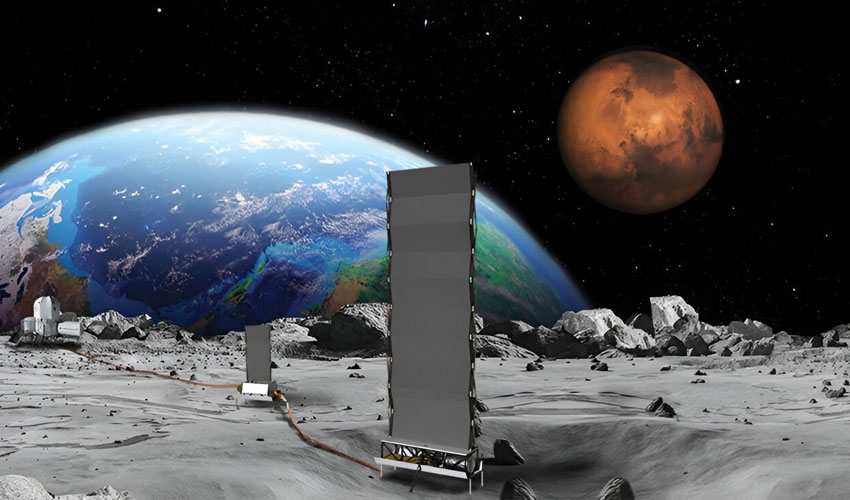
The dream of humans living beyond Earth is moving closer to reality. NASA has announced a bold new roadmap that includes building a permanent base on the Moon and launching a nuclear-powered mission to Mars.
At a high-profile event, NASA Administrator Jared Isaacman unveiled a $20 billion plan to construct a lunar base over the next seven years.
The initiative is part of a broader push to establish a sustained human presence on the Moon, a long-standing goal that gained momentum during the presidency of Donald Trump.
NASA aims to return humans to the Moon through its Artemis 2 mission—the first crewed lunar mission in over 50 years.
The agency framed the plan as a response to intensifying global competition in space, particularly from China, which is targeting a human Moon landing by 2030 and its own lunar base.
NASA says the new program is essential to maintaining US leadership in space exploration.
Three-phase plan
NASA’s lunar base will be developed in three key phases:
Phase One: Frequent Robotic Missions
The first stage will focus on increasing robotic missions to the Moon.
Through the Commercial Lunar Payload Services program, NASA plans up to 30 robotic landings starting in 2027. These missions will test critical technologies such as power generation, mobility, and communications.
Innovative tools like MoonFall hoppers—robotic landers capable of short jumps—will be used to search for resources like water ice.
Phase Two: Semi-Habitable Infrastructure
The second phase will introduce infrastructure capable of supporting astronauts during extended stays.
This includes a pressurized rover from Japan’s space agency, enabling mobility and exploration on the lunar surface.
Phase Three: Long-Term Human Habitation
The final phase will establish permanent human presence.
Plans include:
- Multipurpose habitats from Italy
- A lunar utility vehicle from Canada
- Expanded systems for continuous operations
NASA also announced a pause in its planned lunar orbital station, known as Gateway.
Originally intended as a staging hub for Moon and Mars missions, some of its technologies will now be repurposed for other projects within the new plan.
In a parallel announcement, NASA revealed plans to launch a nuclear-powered spacecraft named Space Reactor-1 Freedom to Mars by 2028.
The spacecraft will use nuclear fission technology to generate power for propulsion—marking the first such mission since the 1960s.
Robotic helicopters to explore Mars
Upon reaching Mars, the spacecraft will deploy robotic drones inspired by Ingenuity helicopter.
These drones will:
- Use cameras and subsurface radar
- Search for water ice
- Identify potential human landing sites
Ingenuity itself completed 72 successful flights after arriving on Mars in 2021, proving the concept of aerial exploration on another planet.
Despite the ambitious vision, questions remain about execution.
NASA has faced internal challenges and proposed funding cuts in recent years, raising doubts about whether such large-scale projects can be delivered on time.