






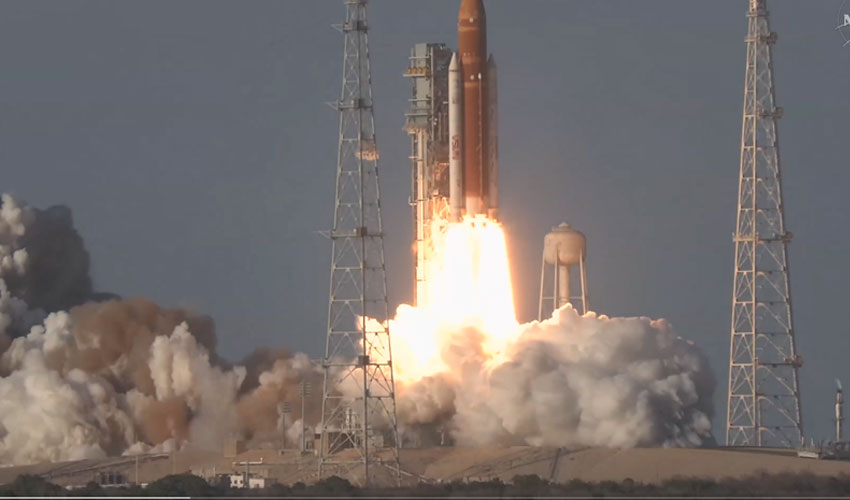
NASA has successfully launched its Artemis II mission, sending four astronauts on a historic voyage around the moon. The mission represents the first time humans have ventured beyond low-Earth orbit in more than half a century.
The 32-storey Space Launch System rocket lifted off from Kennedy Space Center on Wednesday, carrying NASA astronauts Reid Wiseman, Victor Glover, Christina Koch, and Canadian Space Agency astronaut Jeremy Hansen. Tens of thousands gathered to witness the spectacular liftoff.
“On this historic mission, you take with you the heart of this Artemis team, the daring spirit of the American people and our partners across the globe, and the hopes and dreams of a new generation,” said launch director Charlie Blackwell-Thompson.
Liftoff.
— NASA (@NASA) April 1, 2026
The Artemis II mission launched from @NASAKennedy at 6:35pm ET (2235 UTC), propelling four astronauts on a journey around the Moon.
Artemis II will pave the way for future Moon landings, as well as the next giant leap — astronauts on Mars. pic.twitter.com/ENQA4RTqAc
Five minutes into the flight, commander Reid Wiseman reported, “We have a beautiful moonrise, we’re headed right at it.”
Pre-launch tensions
Leading up to the launch, NASA faced heightened tensions as hydrogen fuel was loaded into the rocket, following a prior leak during a countdown test. Engineers carefully monitored the critical phase, successfully loading over 700,000 gallons (2.6 million liters) of fuel without incident.
The hatch is now closed.
— NASA (@NASA) April 1, 2026
The Artemis II astronauts are now strapped into their seats and ready for launch. pic.twitter.com/NWSjgklep9
Additional technical hurdles included issues with the flight-termination system and a battery in the Orion capsule’s launch-abort system. Both problems were swiftly resolved, allowing the mission to proceed on schedule.
Mission plan
Artemis II will begin with one to two days in high Earth orbit, during which astronauts will conduct extensive system checks on life support, propulsion, navigation, and communications.
After completing these checks, Orion will perform a translunar injection burn to set a trajectory toward the moon. The spacecraft will fly behind the moon on a free-return trajectory, reaching its farthest point from Earth before returning.
During the journey back, astronauts will continue testing Orion’s deep-space capabilities, including power systems, thermal controls, and crew operations. The capsule is expected to re-enter Earth’s atmosphere at speeds of roughly 40,233 km/h (25,000 mph) and splash down in the Pacific Ocean for recovery.
Life aboard Artemis II
Astronauts have already enjoyed “epic views” of Earth and space. NASA reported a short-lived communication glitch and a temporary toilet issue, both of which have been resolved. The crew continues to carry out critical testing as they orbit the Earth.
NASA science mission chief Nicky Fox emphasized the mission’s significance: “There are generations who weren’t alive when Apollo launched. This is their Apollo.”