




India has slashed excise duties on petrol and diesel to protect consumers and rein in a potential spike in inflation, while imposing windfall taxes on aviation fuel and diesel exports, amid volatile global oil markets as a result of the Iran war.
Global oil prices have surged past $100 per barrel after the near closure of the Strait of Hormuz, which serves as a conduit for 40% of India's crude oil imports, since the US and Israel first struck Iran on February 28.
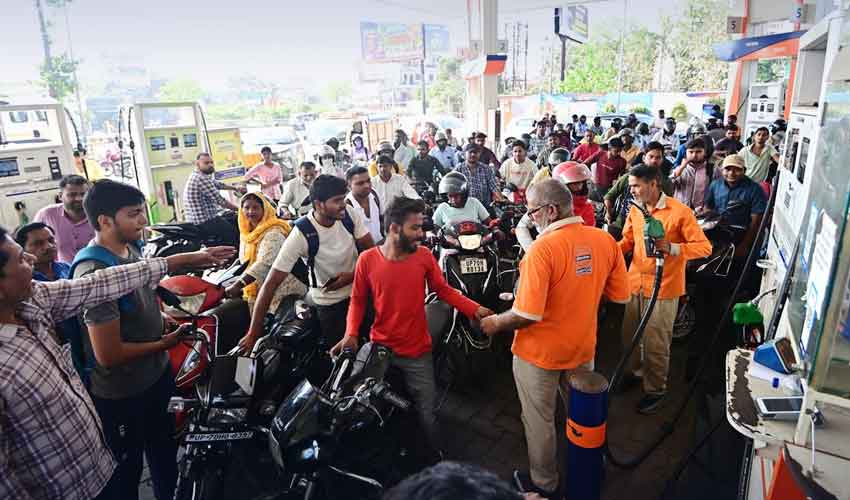
In a government order released late on Thursday, India's finance ministry reduced the special excise duty on petrol to 3 rupees ($0.0318) per litre from 13 rupees earlier. It also cut the duty on diesel to zero from 10 rupees per litre.
The government did not say how much the duty cuts would cost. The move comes ahead of elections next month in four Indian states and one federal territory, with Indian voters known to be extremely sensitive to higher prices.
"Government has taken a huge hit on its taxation revenues to ensure very high losses of oil companies, approximately 24 rupees a litre for petrol and 30 rupees a litre for diesel, at this time of sky high international prices, are reduced," Oil Minister Hardeep Singh Puri said in a post on X.
Madhavi Arora, an economist at Emkay Global, estimated the annualised fiscal hit to be nearly 1.55 trillion rupees. The duty cuts would absorb about 30% to 40% of annual losses of oil marketing companies on auto fuel at current prices, she said.
The yield on 10-year government bonds rose 7 basis points to 6.95%, its highest level in 20 months, while shares of oil marketing companies such as Bharat Petroleum Corp and HPCL rose more than 4% at the open, but later pared gains.
While fuel prices in India are technically deregulated, state-run oil companies, which control 90% of the retail fuel network, do not always raise prices when crude prices increase.
As a result, Indian consumers are shielded from price volatility, with either the government or the oil companies absorbing the increases.
Windfall tax on exports
The diesel export tax was set at 21.5 rupees a litre as well as a 29.5 rupees a litre tax on the export of aviation fuel, the order said.
Between April 2025 and January 2026, India exported 14 million metric tons of gasoline and 23.6 million tons of gasoil. Most Indian refiners have stopped exporting fuels, and Reliance Industries is the country's biggest fuel exporter.
India's Finance Minister Nirmala Sitharaman said the government will ensure that there is no shortage in supply of petrol, diesel and jet fuel.
It will support oil marketing companies so that citizens are spared from any price hikes and also ensure that prices of jet fuel do not go up, the minister told news agency ANI.
India is the world's third-biggest oil importer and consumer and imports most of its fuel.
In a letter dated Thursday, the petroleum ministry said it will raise the allocation of liquefied petroleum gas to commercial and industrial users by 20%, taking total supply to 70% of pre-crisis levels.
The increase builds on an existing 50% allocation, with priority to be given to sectors such as steel, automobiles, textiles and other essential industries. India had cut gas allocation for non-cooking purposes after the start of the Iran war.
India consumed 33.15 million metric tons of cooking gas last year, with imports accounting for about 60% of demand. About 90% of those imports came from the Middle East.
Prime Minister Narendra Modi and his government have stressed adequate arrangements are in place, including for the supply of fertilisers for the summer sowing season and coal to meet rising electricity demand.