




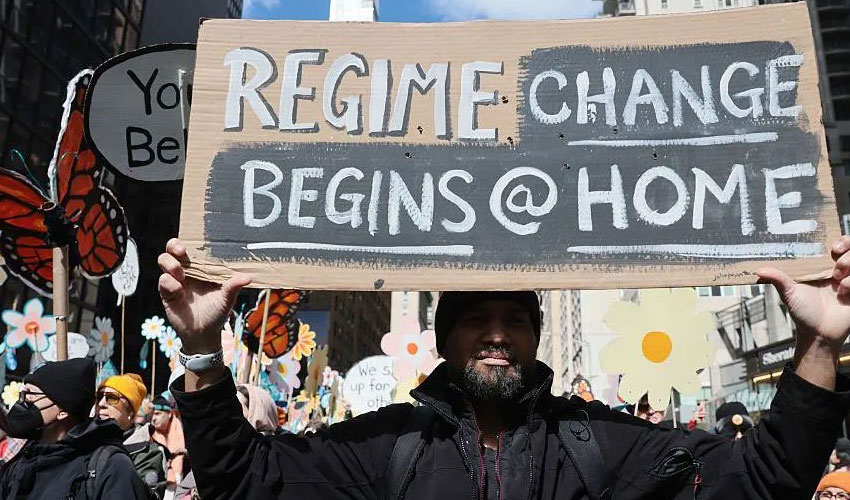
Tens of thousands of Americans took to streets nationwide on Saturday in the third iteration of the “No Kings” protests, criticizing President Donald Trump’s policies on immigration, the war in Iran, and what organizers call overreach of executive power.
From New York to Los Angeles, protesters rallied in major cities across the U.S., holding signs, chanting slogans, and demanding accountability from the administration. Organizers described the events as a stand against what they call “tyrannical rule” by Trump and his allies, declaring that “power belongs to the people, not wannabe kings.”
In Washington, D.C., crowds filled the National Mall and the steps of the Lincoln Memorial. Marchers carried effigies of Trump, Vice President JD Vance, and other officials, calling for their removal and arrest.

One of the largest gatherings occurred in St. Paul, Minnesota, highlighting outrage over the January deaths of Renee Nicole Good and Alex Pretti, who were killed by federal immigration agents. Thousands lined the streets around the State Capitol, with high-profile Democrats and musician Bruce Springsteen addressing the crowds. Springsteen performed his anti-immigration enforcement song, “Streets of Minneapolis.”
Incidents during protests
While most demonstrations remained peaceful, some cities reported clashes with law enforcement. In Los Angeles, federal agents used non-lethal measures to disperse crowds near the Roybal Federal Building after objects were thrown at officers. Two arrests were made following assaults on federal personnel.
In Dallas, minor scuffles broke out between protesters and counter-protesters, resulting in several arrests. Police confirmed that streets in Manhattan’s Midtown were temporarily shut down to accommodate crowds marching through Times Square.
Widespread reach of 'No Kings' rallies
The protests also extended to smaller towns, including Shelbyville, Kentucky, and Howell, Michigan, with populations around 10,000, showing nationwide support for the movement. Demonstrations addressed concerns over the war in Iran, federal immigration policies, and the expansion of presidential powers since Trump returned to office in January 2025.
This marks the third iteration of No Kings rallies, following a previous nationwide protest in October that drew nearly seven million people. Several states had mobilized the National Guard as a precaution, but organizers emphasized that the events remained largely peaceful.
Trump’s response
The White House dismissed the protests as “Trump Derangement Therapy Sessions,” claiming media attention exaggerated the impact. Trump has defended his actions, saying executive orders and federal deployments are necessary to restore order, while rejecting claims of authoritarian behavior.