





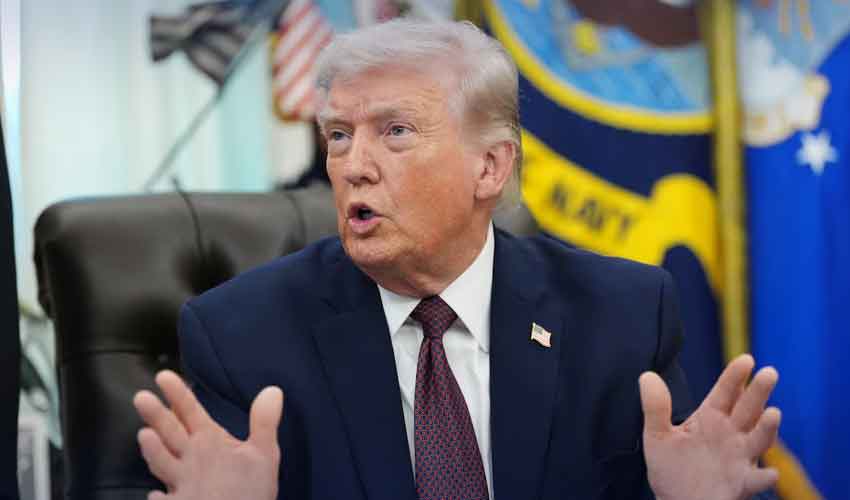
US President Donald Trump has claimed Iran’s new leadership has requested a ceasefire, even as Washington intensifies military action and questions its future in NATO.
Global tensions escalated further as Trump made a series of strong statements on the Iran war and NATO. Speaking ahead of a national address, Trump outlined US strategy, ceasefire conditions, and strained ties with allies.
President Donald Trump said Iran’s new leader has asked the United States for a ceasefire. In a Truth Social post, Trump stated that Washington would only consider a ceasefire once the Strait of Hormuz is “open, free, and clear.”
“Until then, we are blasting Iran into oblivion,” he said, adding that the US would evaluate the request under those conditions.
US plans quick exit but warns of ‘spot hits’
Trump told Reuters that the United States would be “out of Iran pretty quickly.” He added that the US could return for “spot hits” if necessary after withdrawing forces.
“We’re going to be out pretty quickly,” he said, while claiming that US actions had ensured Iran would no longer be capable of developing nuclear weapons.
Also Read: Trump claims US war on Iran could end in 2–3 weeks
Trump said Iran “won’t have a nuclear weapon because they are incapable of that now.” He also claimed that the US had already carried out regime change in Iran and would monitor the country through satellite surveillance.
“We are sending Iran back to the Stone Age,” he said in a strong statement on social media.
Strait of Hormuz central to ceasefire
The US president stressed that reopening the Strait of Hormuz remains a key condition for ending the conflict. He noted that the US would consider a ceasefire only once the strategic waterway is secure.
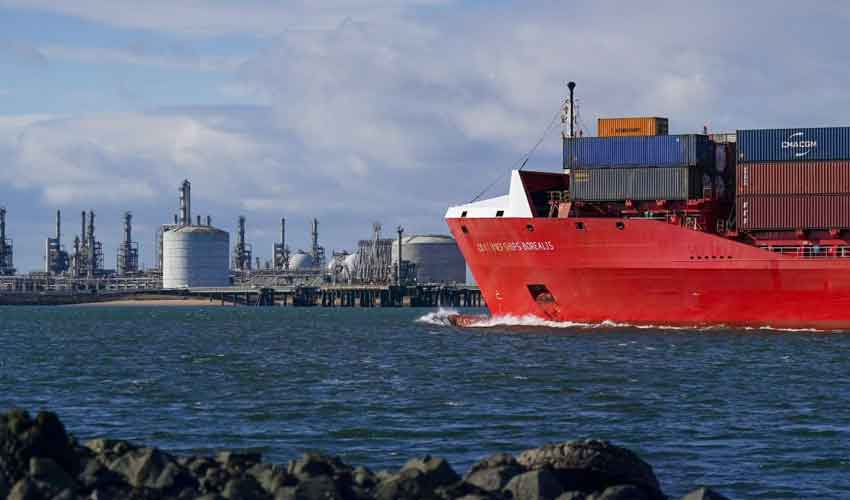
The strait is a critical global route for oil and gas shipments, making it central to international economic stability.
Trump also signaled that he is “absolutely” considering withdrawing the United States from NATO. He criticised European allies for refusing to send ships to help unblock the Strait of Hormuz.
“You don’t have much of an alliance if countries are not willing to stand with you,” he said.
NATO a ‘paper tiger’
In an interview with Britain’s Daily Telegraph, Trump described NATO as a “paper tiger.” He said he had “moved beyond reconsideration” of US membership in the alliance.
He also claimed Russian President Vladimir Putin is aware of NATO’s weaknesses.
European leaders responded with concern but avoided direct confrontation. France’s junior army minister Alice Rufo said NATO is designed for Euro-Atlantic security and not for operations like the Strait of Hormuz.
Poland’s Defence Minister Wladyslaw Kosiniak-Kamysz called for calm, stressing that both NATO and US power depend on each other. Germany reiterated its commitment to NATO, while a spokesperson noted that Trump’s comments were not unprecedented.
British Prime Minister Keir Starmer said he would act in the UK’s national interest “whatever the noise.” He emphasised closer economic and defence ties with Europe in light of instability caused by the Iran war.
Also Read: UK to focus on national interest, won’t join Iran war: Starmer
Trump, however, criticised Britain for not joining the US-led campaign, claiming the UK lacks naval strength.
The Iran war has deepened divisions between the US and Europe. Tensions have been building since Trump’s return to office in 2024 over issues including trade, security, and foreign policy.
Trump has also warned allies to “start learning how to fight for yourself,” suggesting reduced US support in the future.
Military cooperation disputes
France refused to allow Israel to use its airspace for US weapons transfers, while Italy denied US aircraft access to a key airbase in Sicily. Spain went further by closing its airspace to US planes involved in operations against Iran.
Both France and Italy said their decisions were in line with standard policies.
Experts have warned that Trump’s remarks could undermine NATO’s collective defence principle. This principle, known as Article 5, states that an attack on one member is considered an attack on all.
Also Read: US confronting Russia, China over Iran, asserts Hegseth
US Defence Secretary Pete Hegseth declined to reaffirm this commitment, saying the decision ultimately rests with the president.
Trump said the war’s end timeline remains unclear but insisted the US would withdraw soon. He maintained that decisions would be guided by national interest, regardless of external pressure.
As diplomatic and military tensions continue, the global balance of power faces increasing uncertainty.